Collecting | Yellowstone
There are many ways to remember a place.
You can take photographs. Buy the postcard. Bring home the sticker. Write down where you went and what you saw.
Or you can begin to collect the place while you are still inside it.
That’s what I found myself doing in Yellowstone.
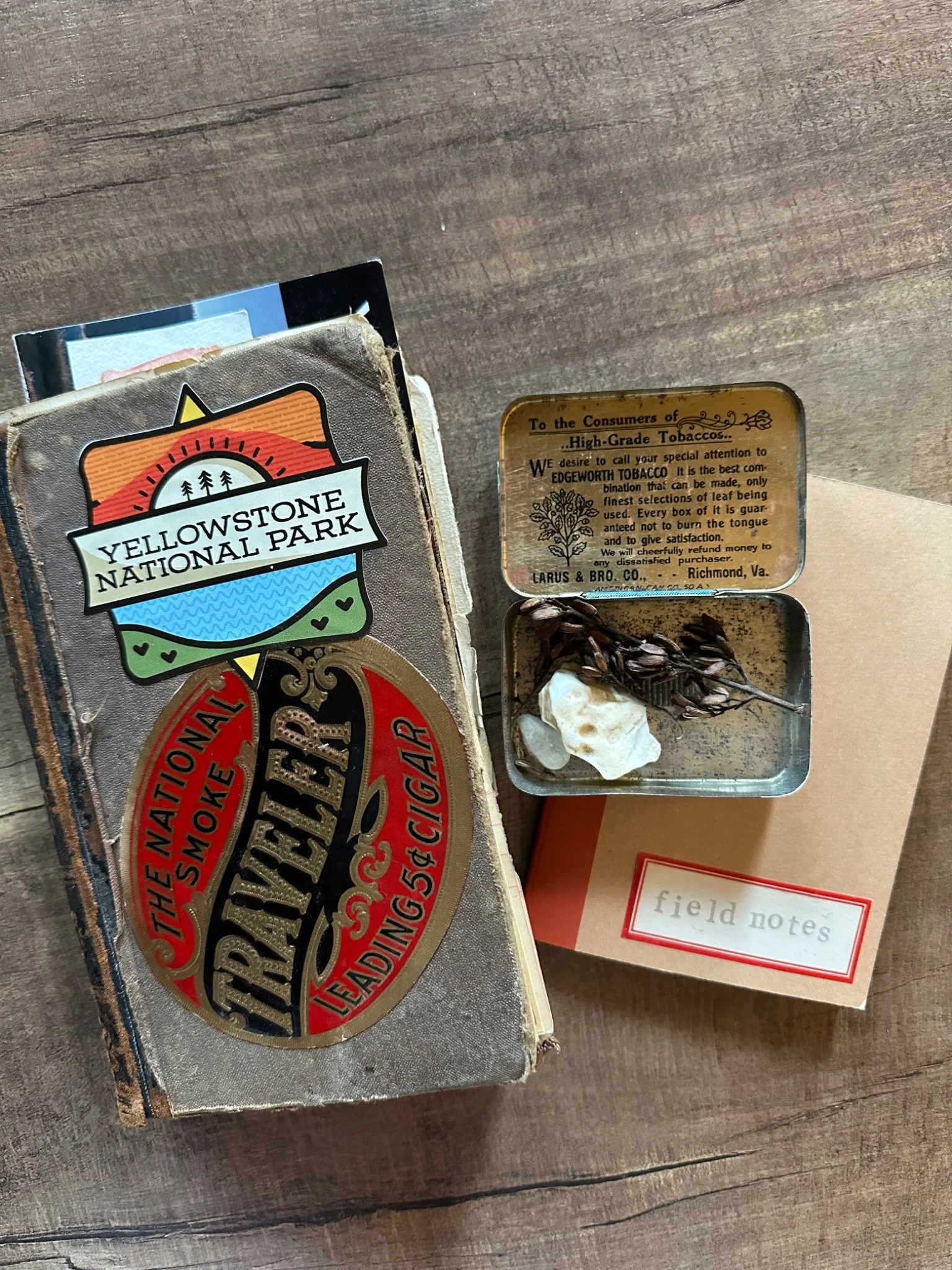
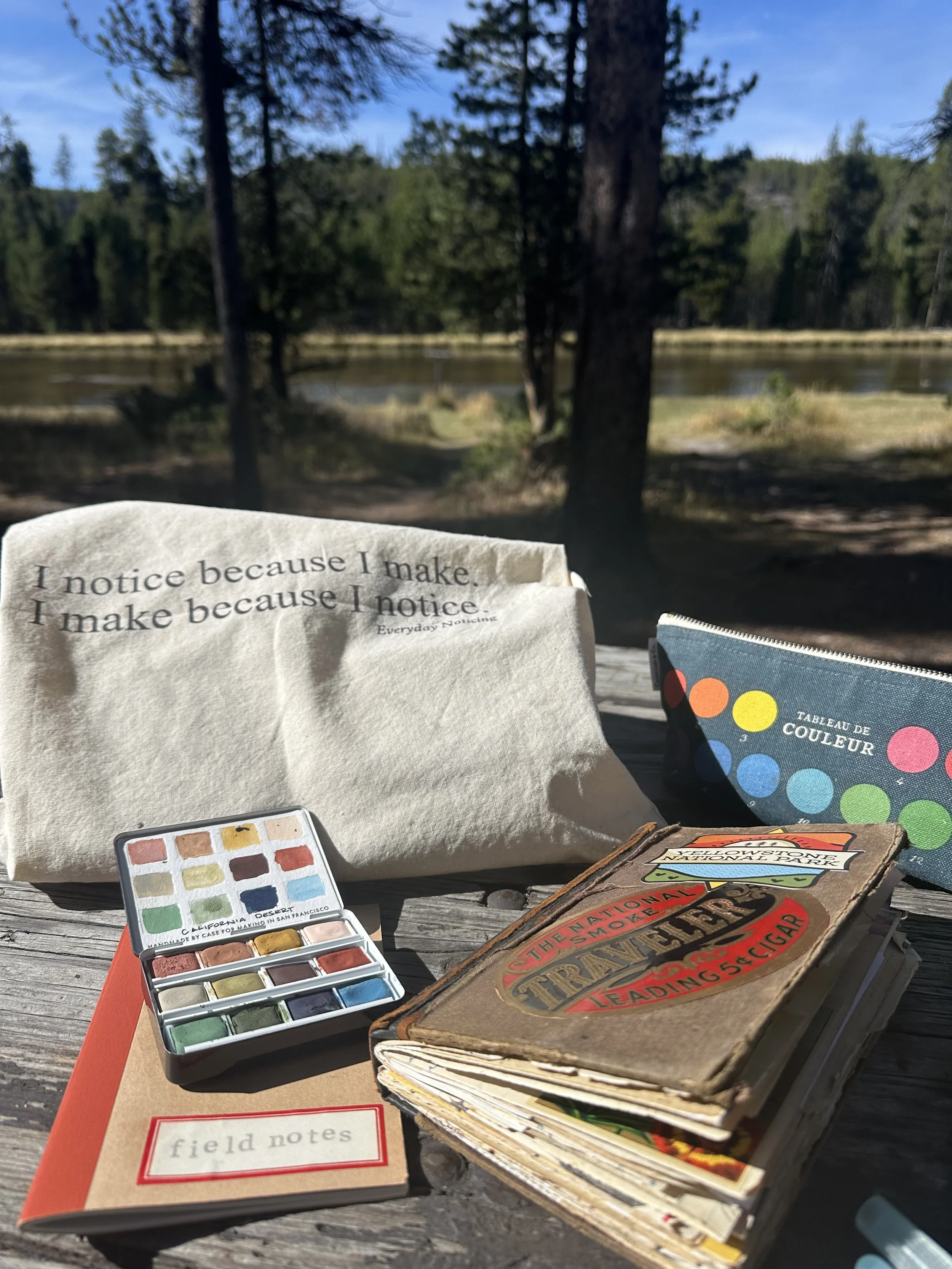
I arrived with a battered old book I’d turned into a travel journal, a tiny watercolor palette, a little notebook for field notes, a vintage tobacco tin, a pen, and a canvas bag that said:
I notice because I make.
I make because I notice.
Which, it turns out, was exactly the right equipment.
Not because I intended to make beautiful pages while sitting beside geysers.
I didn’t.
I wanted something much simpler.
I wanted to pay attention.
Collecting color
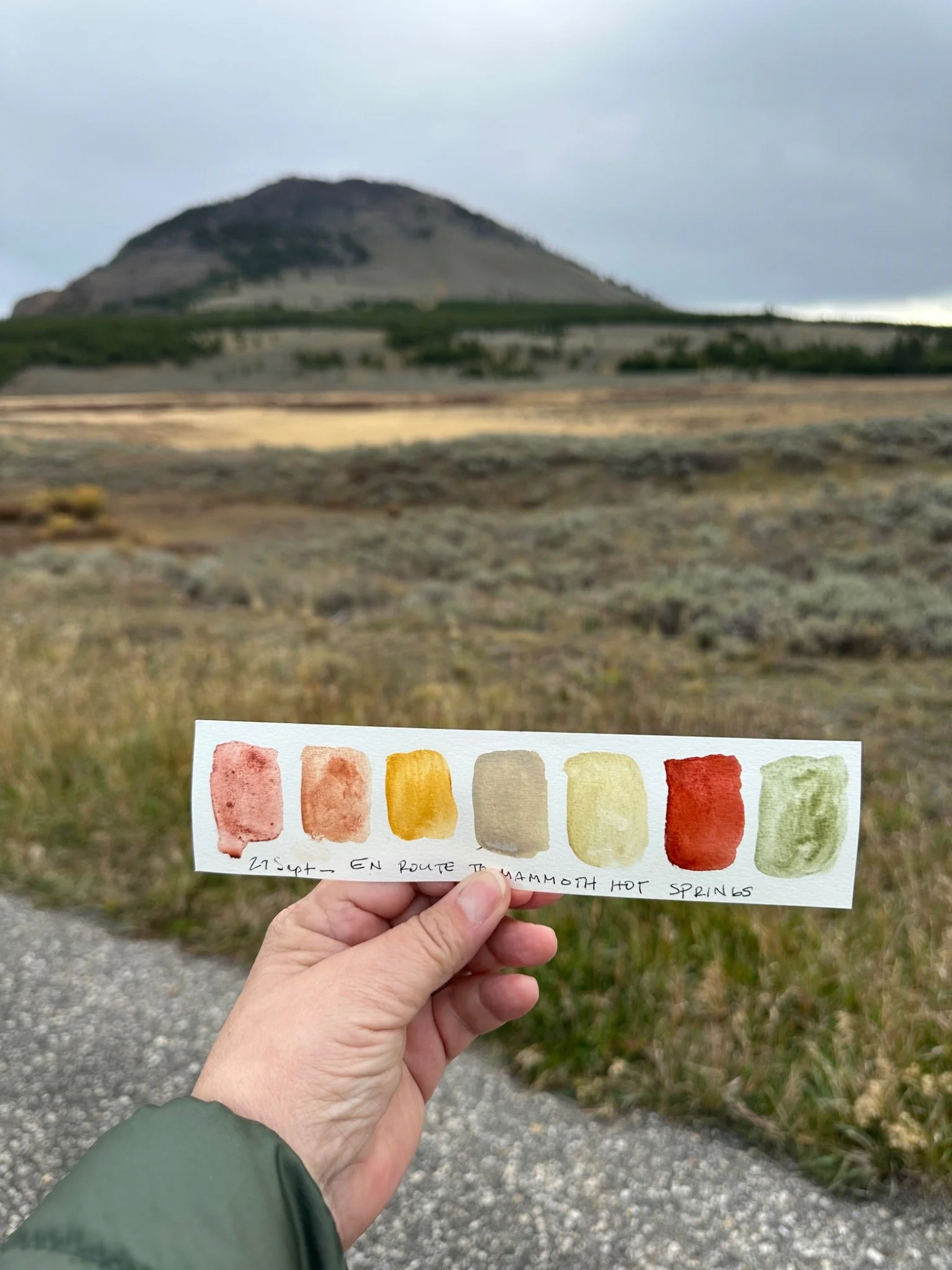
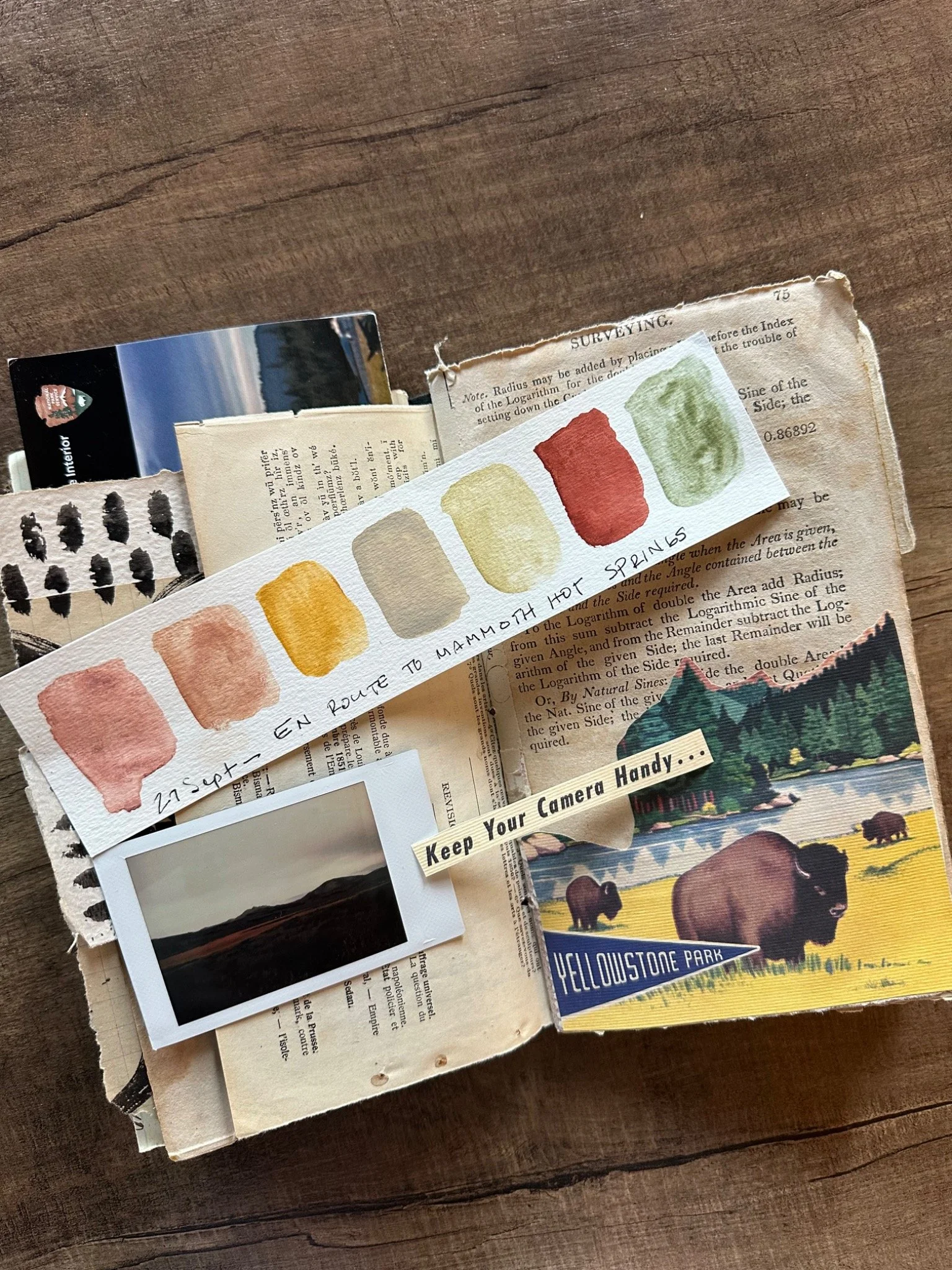
One morning, on the way to Mammoth Hot Springs, I stopped and painted seven little rectangles.
Dusty rose. Rust. Ochre. Stone. Sulfur yellow. Brick red. Sage.
They weren’t colors I had chosen in advance. They were the colors the landscape handed me.
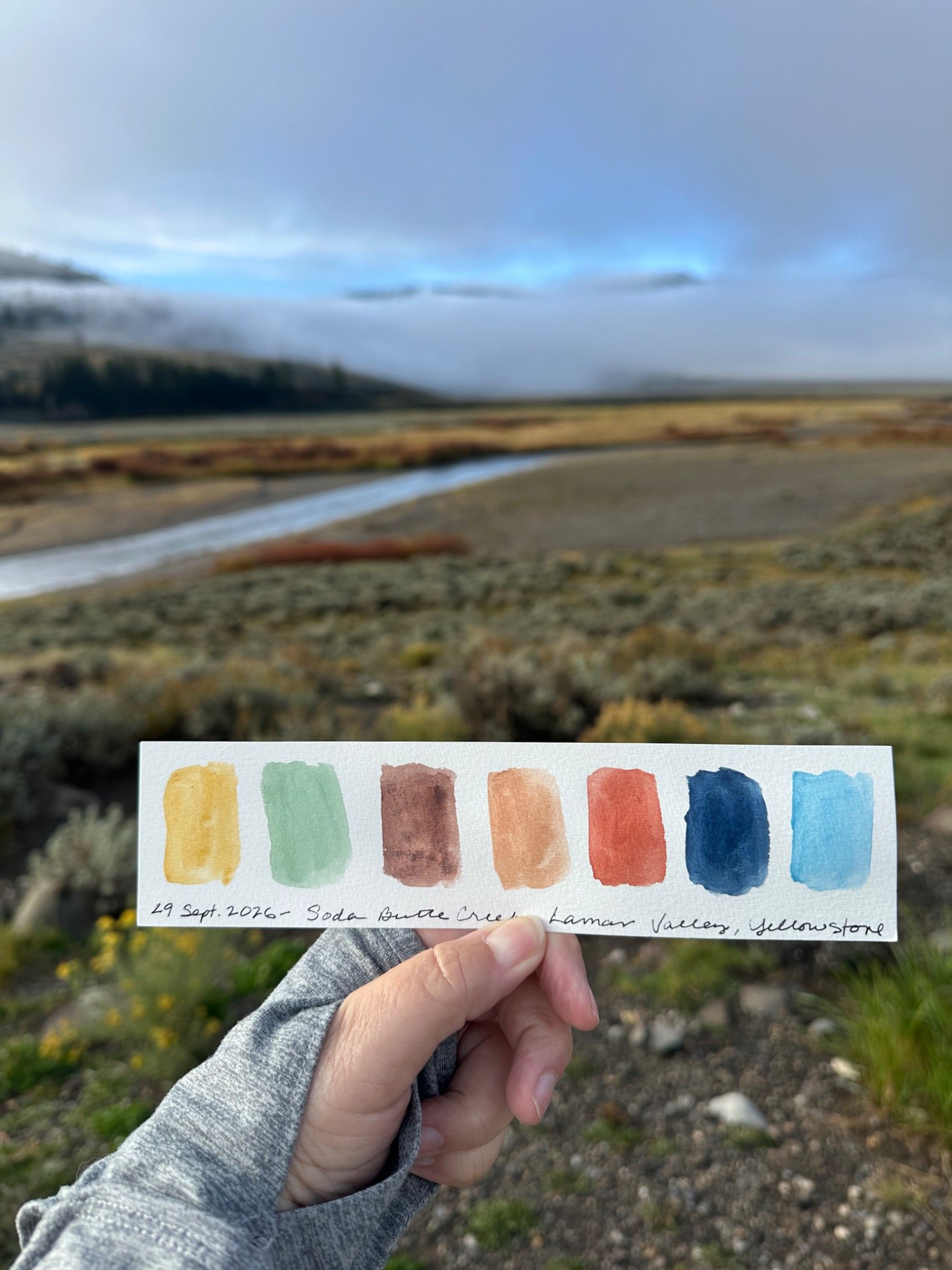
Another day, beside Soda Butte Creek in Lamar Valley, the palette changed completely: mustard, pale green, brown, peach, red, deep blue, sky.
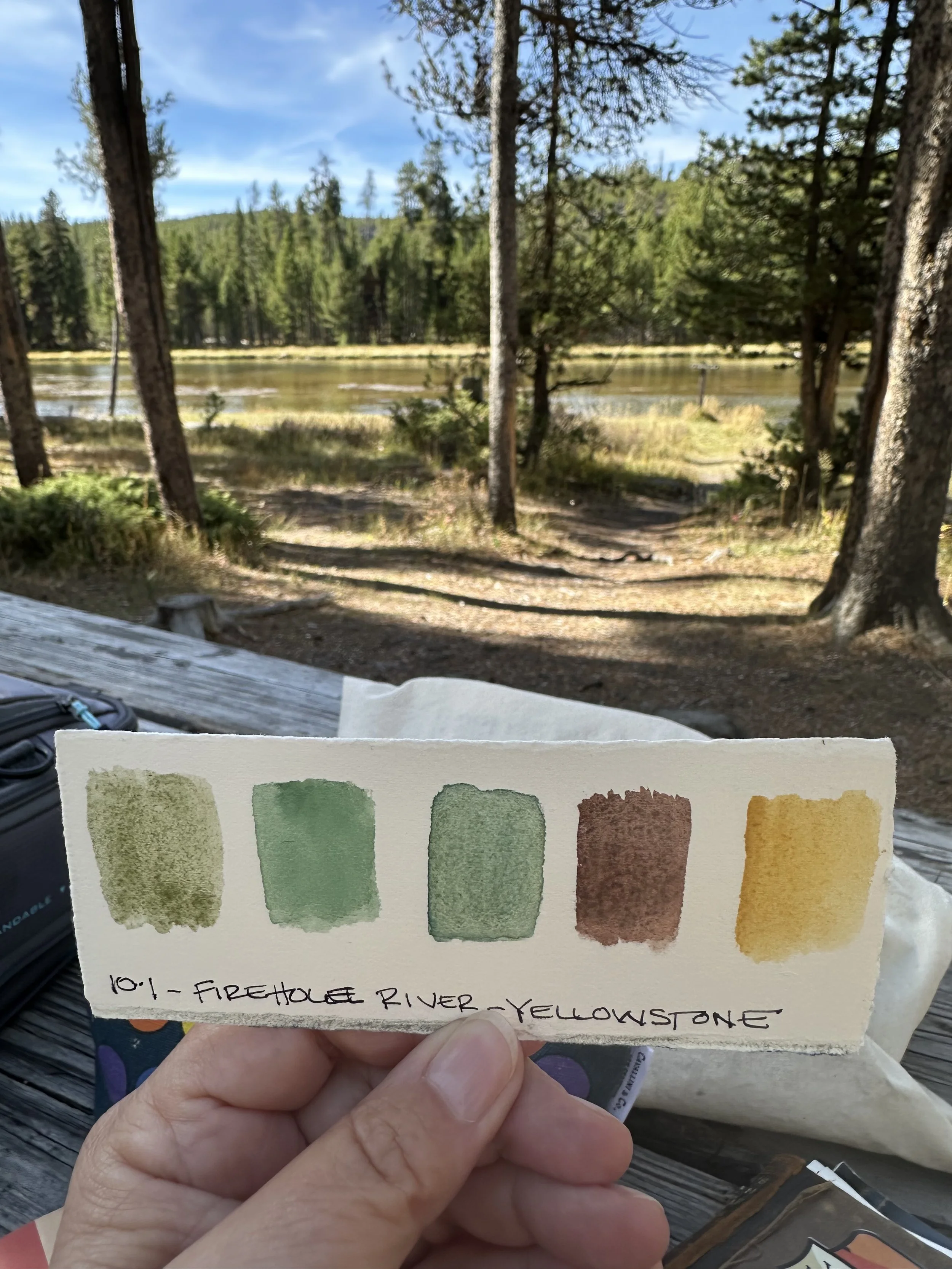
At the Firehole River: lichen, pine, moss, earth, gold.
Tiny landscapes without landscapes.
No drawing required.
Just:
What color is this place?
And suddenly I was looking differently.
Not at Yellowstone.
Into it.
Collecting marks
Once you begin looking this way, almost everything becomes material.
The dark silhouettes of pine trees.
The enormous plume of steam rising from Grand Prismatic.
The circles and mineral stains around hot springs.
The rough geometry of stone buildings.
The curve of an old iron door.
The woven pattern of a rocking chair on a lodge porch.
The typography on a park sign.
Even the warning signs.
Wild animals are dangerous. Do not approach.
Of course.
I began making little marks in my journal that weren't trying to represent Yellowstone perfectly.
They were simply evidence that I had looked.
Collecting things
I also carried a tiny vintage tobacco tin.
It became my boundary.
If I found something small and ordinary that I was permitted to take, and it fit inside the tin, I could consider bringing it home.
A little stone.
A dried bit of plant material.
A seedpod.
Nothing precious.
Nothing that would announce itself from a gift-shop shelf as YELLOWSTONE SOUVENIR.
Just small things that had caught my attention.
The tin kept the collecting from becoming acquiring.
That distinction matters to me.
I wasn't trying to possess Yellowstone.
I was making a small record of having been there.
A note about collecting in wild places: The stones, leaves, seedpods, and other natural objects I brought home were collected outside the boundaries of Yellowstone and our other national parks. Inside the parks, everything stayed exactly where I found it. Part of noticing a place is knowing when the most loving way to collect something is with a photograph, a sketch, a color, or a memory. Take only photographs; leave only footprints.
Collecting paper
Then there were the scraps.
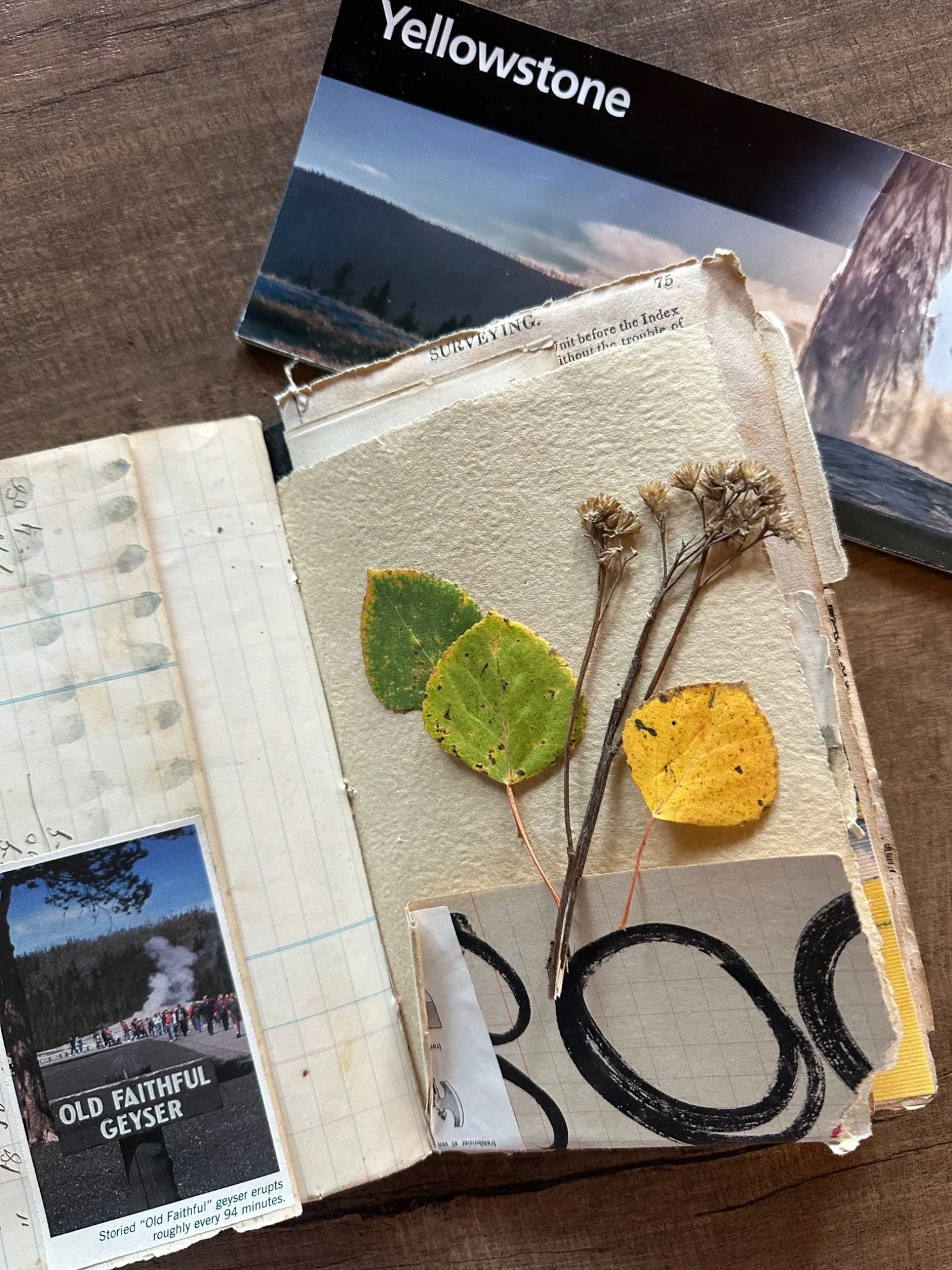
Maps. Brochures. Stickers. Receipts. Postcards. Photographs. Bits of printed ephemera.
Some went directly into the old book. Others waited between its pages.
I tucked leaves and dried stems among torn pieces of vintage paper. I added photographs and words. I painted trees. I glued things down and left other things loose.
The book got fatter.
The edges became ragged.
Things stuck out.
Perfect.
Because I didn't want a pristine record of the trip.
I wanted a book that looked as though it had traveled through Yellowstone with me.
The collecting changed the trip
This may be the part I love most.
Collecting wasn't something I did after the experience.
It changed the experience itself.
Because once I wondered what color Lamar Valley was, I had to actually look at Lamar Valley.
Once I began noticing the stonework of the old park buildings, I started seeing individual stones.
Once I began collecting words, signs became interesting.
Once I wondered what marks the trees might make on a page, I started looking at the spaces between their branches.
The landscape became more particular.
And that's what noticing does.
It turns a beautiful place into this place, on this day, as I encountered it.
I don't need my journal to preserve Yellowstone.
It can't.
I don't need the little stone in my tin to hold the afternoon when I found it.
It can't do that either.
But these things can become evidence.
I was here.
I saw this.
This caught my attention.
For some reason, among all the things I could have noticed, I noticed this.
And perhaps that last sentence is the most interesting one of all.
Collecting | Yellowstone
Since coming home, I've been thinking about all of this as Collecting | Yellowstone.
Not a travel journal, exactly.
Not a sketchbook.
Not scrapbooking.
Not even really documenting a trip.
It's a practice of encountering a place through attention.
Collect the colors.
Collect the marks.
Collect the words.
Collect the scraps.
Collect the tiny things.
Collect what surprises you.
Collect what keeps tugging at your sleeve.
And then make something from what you noticed.
A book.
A folio.
A box.
A collection of painted color strips.
A little cabinet of curiosities.
Something that says:
Here is what I saw.
Not everything.
Just what was mine to notice.
And here's the wonderful thing I've realized:
You don't need Yellowstone.
You can do this in Paris or Portland. In a museum or a grocery store. On a train platform. At the beach. Around your neighborhood. At the kitchen table on an ordinary Tuesday.
Because the real practice isn't collecting Yellowstone.
It's collecting your life.
Wherever you happen to be standing.
What if we did this together?
As I was collecting Yellowstone—its colors and marks, scraps and stories—I kept thinking about Switzerland.
Next June, I'll be taking a small group of creative women into the Swiss Alps, and this is the kind of practice we'll carry with us: noticing a place closely, collecting what catches our attention, and making something from what we've gathered.
Not to make a perfect record of Switzerland.
To make our record of being there.
Collecting | Switzerland is seven days of exploring, noticing, making, and seeing what happens when we give a beautiful place our full attention.
There are still spaces at the table.